Melly’s Musings
WHAT HAVE WE DONE TO PERFUMERY?
Inspired by “Simplicity and Complexity” in Perfumery: Practice and Principles (1994), by Robert R. Calkin and J. Stephan Jellinek.
By Melanie Jane
In 1994, Calkin and Jellinek wrote that the underlying structure of a well-made perfume should be simple. Its carefully judged complexity is what gives it richness, harmony and that indefinable something we recognise as quality.
W. A. Poucher told his students that perfumery had only three rules: simplicity, simplicity and again simplicity. Edmond Roudnitska reached much the same conclusion after becoming disillusioned with perfumes that had dissolved into mille fleurs: everything blooming at once, with nothing saying very much.
But simplicity does not mean thin, cheap or boring. Naturals arrive carrying their own complexity. A flower absolute may contain hundreds of constituents, creating texture and movement before the perfumer has added anything else.
Jean Carles compared jasmine absolute to butter in haute cuisine. Margarine may perform a similar function, but the result is never quite the same. You can create an inexpensive fragrance with the recognisable shape of Chanel No. 5, but without rose and jasmine absolutes, you lose something of the original’s subtlety, richness and beauty.
The skill is not simply knowing what to add. It is knowing what to leave out. As Mozart replies in Amadeus when accused of using too many notes, the music contains precisely as many as it needs.
No more.
No fewer.
I learned that lesson in my own way.
About ten years ago, on my first day at a summer course in Grasse, I sat beside the school’s director at lunch and gave him a perfume I had created called Bohemian.
It contained only four materials, including rose and patchouli.
I loved it. My customers loved it. Every small batch sold out, and people wearing it received compliments.
He smelled it.
“It’s not awful,” he said, a compliment by French standards.
To me it was a standing ovation.
Then he suggested that it needed more ingredients.
But why?
If four materials created a beautiful, complete perfume that people wanted to wear, what exactly would ingredient number five prove?
Would it improve the perfume, or merely make the formula longer?
Somewhere along the way, complexity had become confused with sophistication. A short formula could be dismissed as too simple, regardless of what it actually smelled like. More materials seemed to mean more expertise and more value.
But the nose doesn’t count ingredients.
It only knows whether something works.
And that matters now.
Perfumery appears to be living inside a bubble.
Every year brings thousands upon thousands of launches — and those are only the ones we hear about.
At Beautyworld Middle East, I saw bottles shaped like ships, dolphins, coffins, macarons and ice creams. Bottles covered in gold, crystals and ornamentation. One brand appeared to offer close to two hundred fragrances, as though somewhere among them there must be something somebody would buy.
Churn them out. Dress them up. Find an influencer. Call them luxurious, disruptive, exclusive or addictive.
Then begin again next month.
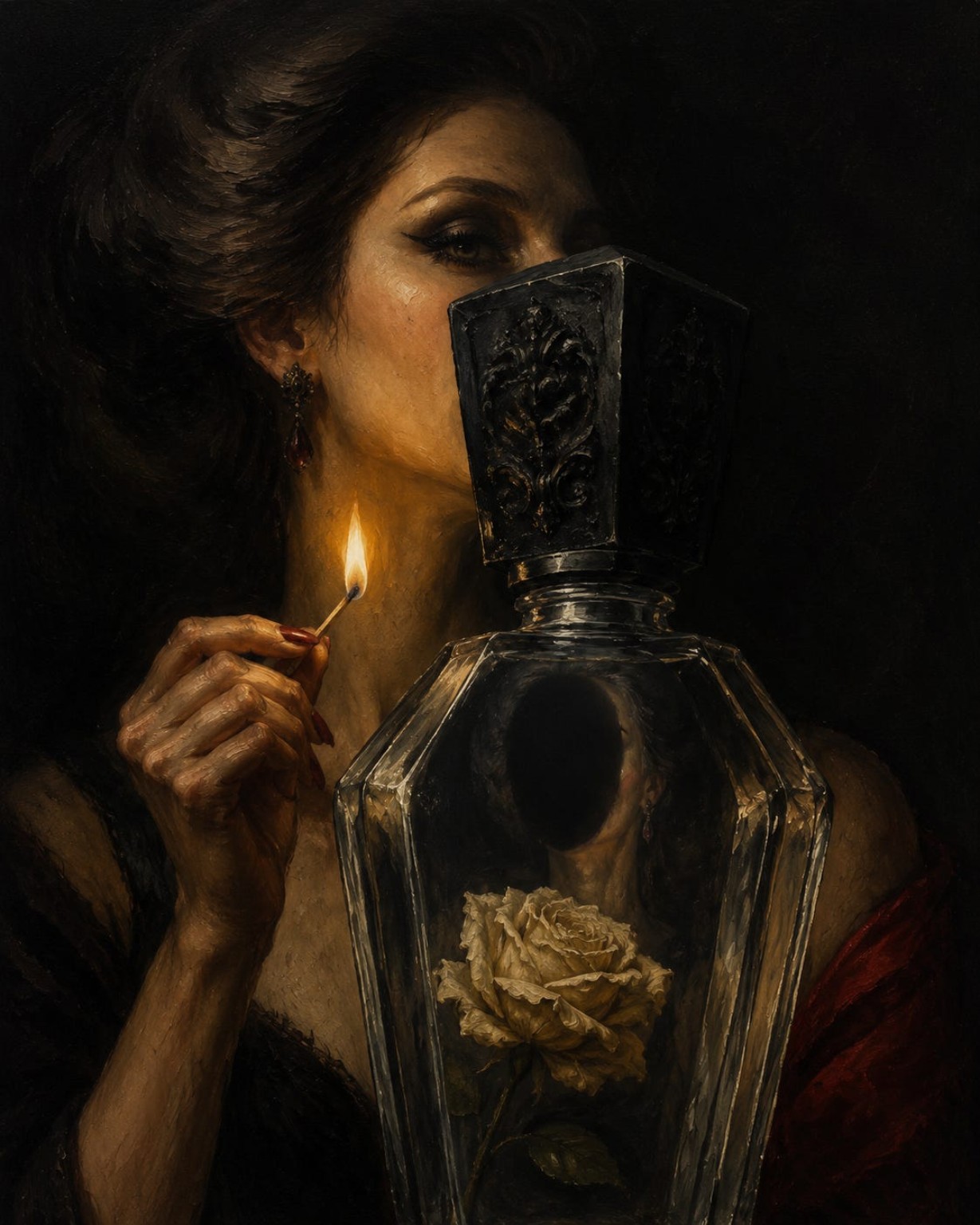
At times, more imagination seemed to have gone into designing the coffin than composing whatever had been buried inside it.
Consumers are overwhelmed. There are too many launches, too many flankers, too many choices, too many influencers, too many opinions and far too much bollocks.
When everything is shouting for attention, eventually you begin to long for silence.
When I interviewed Bernard Dennery of Marcel Franck, he wondered whether there would ever be another truly flabbergasting fragrance.
He meant something original. A masterpiece. A perfume that altered the air around it, astonished the people who smelled it and changed perfumery afterwards.
I understood his pessimism.
Masterpieces cannot be created to a monthly launch schedule. Originality does not come from studying last year’s bestseller and making it sweeter, louder or longer-lasting.
But I haven’t entirely given up.
This is why I seek out smaller independent perfumers. Synthetics are essential to commercial modern perfumery, but small-batch work often leaves more room for naturals because the perfumer is not producing millions of bottles to a corporate cost sheet.
In Grasse, I bought a perfume created by Didier using Indian tuberose, Indian jasmine and orange blossom. It is 95 per cent natural, exquisitely beautiful and somehow both simple and extraordinarily complex. At €70 for 100 ml, it also proves that a predominantly natural perfume does not automatically need to cost hundreds — or thousands — of euros.
Small production may help. Didier’s skill certainly does. He knows when to stop and lets exceptional materials speak.
Either way, it can be done.
I know because I’ve smelled it.
But the industry is not alone in this. It keeps making what we keep buying.
Calkin and Jellinek ended their chapter on a sad note. Even in 1994, they observed that consumers were becoming less concerned with the beauty and subtlety of perfume than with strength and staying power.
Thirty-two years later, look beneath almost any perfume review and the same question appears:
How long does it last?
Not: Is it beautiful? Is it moving? Is it exquisitely made?
Just: Does it perform?

Perhaps perfume has not forgotten how to be beautiful.
Perhaps we have forgotten to ask.