Melly’s Musings
The Jo Malone Lawsuit
When You Sell Your Name, Who Owns You?
By Melanie Jane
A luxury fragrance battle that raises uncomfortable questions about branding, identity, and what really happens when founders sell themselves along with the business.
The fragrance world has erupted into legal drama recently after Estée Lauder Companies filed a lawsuit against Jo Malone (the woman) and Zara, over their ongoing fragrance collaboration.
And honestly? The entire thing smells less like perfume and more like a very expensive identity crisis.
For people outside the industry, this all seems rather baffling.
After all, Jo Malone is Jo Malone… isn’t she?
Well, legally speaking — not exactly.
Back in 1999, Jo Malone sold her hugely successful brand, Jo Malone London, to Estée Lauder Companies whilst remaining on as Creative Director. At the time, it seemed like the fairy-tale ending every founder dreams of: massive global expansion, corporate backing, and the chance to take a British fragrance empire worldwide.
Then life intervened in the most brutal way possible.
Jo Malone was diagnosed with breast cancer and underwent aggressive chemotherapy treatment. By all accounts, Estée Lauder supported her enormously throughout that period. She later spoke openly about temporarily losing her sense of smell after treatment — which, for a perfume expert, is a bit like asking Elton John to work with oven gloves on.
Eventually, she stepped away from the company.
And this is the important bit.
“When she sold the business, she didn’t just sell the company. She sold the commercial rights to the name ‘Jo Malone’ within fragrance.”
That clause would later become the entire problem.
After a non-compete period, she eventually launched her new brand, Jo Loves — a separate company entirely.
So far, so normal.
But several years ago, Zara approached her to collaborate on a fragrance collection. The range included scents such as Fashionably London and Elegantly Tokyo — fragrances positioned at a dramatically lower price point than Jo Malone London.
And here’s where things become commercially awkward.
Because while fragrance insiders understand the distinction between:
Jo Malone London
Jo Loves
and Jo Malone the person…
…ordinary consumers often do not.
“Most people simply say: ‘Oh, I’m wearing Jo Malone.’ They don’t say: ‘Oh, I’m wearing Jo Malone London, a brand wholly owned by Estée Lauder and no longer creatively connected to Jo Malone herself.’”
Because nobody talks like a corporate disclaimer.
And that, arguably, is the entire heart of this lawsuit.
According to reports, Estée Lauder alleges that the Zara collaboration risks consumer confusion and breaches the original agreement surrounding the use of the Jo Malone name in fragrance marketing.
Now, to be clear, Zara has denied wrongdoing and filed its defence, while Estée Lauder has publicly maintained that the terms of the original sale were very clear. This remains an ongoing legal matter.
But commercially, the questions are fascinating.
Why now?
Why after years of collaboration?
Why after multiple launches?
And this is where things become less about contracts and more about brand perception.
Because Jo Malone London occupies the luxury fragrance space. A bottle may retail for well over £100. Meanwhile, Zara fragrances associated with Jo Malone’s name sit at around £40.
So the question naturally becomes:
Could consumers begin associating “Jo Malone” with accessible high-street fragrance rather than luxury fragrance?
Could this potentially dilute the exclusivity of the original brand?
Could some consumers decide: “Well, if Jo Malone is making perfumes for Zara now, why am I paying luxury prices elsewhere?”
Again — those are questions, not conclusions.
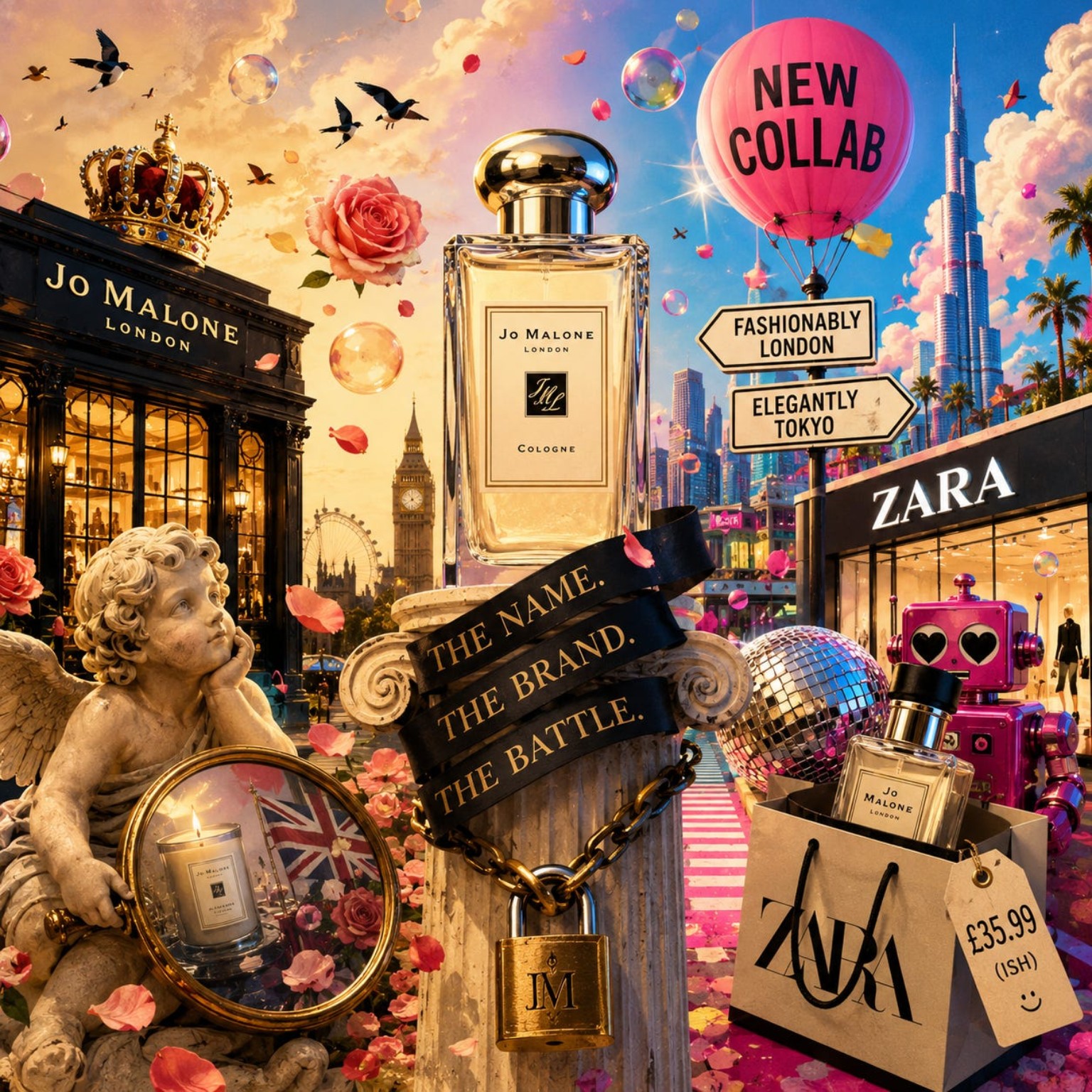
“Luxury companies guard perception like dragons sitting on piles of scented gold.”
And perception is everything.
Particularly when the founder’s own face, story, and personality were instrumental in building the original brand identity.
Which is why this case feels so emotionally strange.
Because this isn’t some anonymous corporate trademark battle.
It’s essentially a woman fighting over the commercial use of her own name.
And Jo Malone herself has publicly admitted that selling it was “the biggest mistake” of her life.
That’s the tragedy underneath the headlines.
Not villainy. Not scandal. Regret.
But — and this is the uncomfortable part — regret does not erase contracts.
And honestly, I find the branding decision itself rather baffling.
Because if the contract surrounding the name was supposedly so clear, why place “Jo Malone” so prominently in fragrance collaborations at all?
Why create advertising that consumers could easily interpret as: “Jo Malone perfumes at Zara”?
Especially in an industry where social media compresses nuance into five-second scrolling chaos and half the internet still believes Jo Malone personally creates every Jo Malone London fragrance today.
And this is where social media arguably complicates things even further.
Jo Malone has publicly stated that she believed she was being transparent by using wording such as “Jo Malone CBE, founder of Jo Loves” on fragrance packaging. In her view, that distinction may have felt clear enough.
But social media marketing rarely operates with that level of nuance.
One Instagram advertisement currently circulating online simply reads: “Zara X Jo Malone.”
No mention of Jo Loves. No clarification about the separation from Jo Malone London. Just “Zara X Jo Malone” alongside the fragrances.
And realistically, what is the average consumer supposed to take from that?
Because when most people hear the words “Jo Malone,” they immediately think of the luxury fragrance brand — not the legal distinctions behind it.
So while the packaging itself may have attempted to create separation, social media advertising potentially blurred those lines all over again.
And in a branding dispute centred around consumer confusion, that distinction suddenly becomes very important indeed.
Many consumers still don’t realise she left years ago.
Some don’t even know Jo Loves exists.
So from a branding perspective, this was always likely to become murky.
And before anyone starts sharpening pitchforks, this is not unique to fragrance.
Fashion has been doing this dance with identity for decades.
Halston became one of the most famous cautionary tales after selling the rights connected to his name and later struggling with the consequences of losing control over it.
Bobbi Brown sold her company to Estée Lauder, later launching a different venture entirely under the name Jones Road, a far cry from her actual name.
Tom Ford eventually sold the Tom Ford brand in a multibillion-dollar deal.
This is increasingly common because founders themselves become the product.
Their face becomes the logo. Their personality becomes the campaign. Their story becomes the marketing.
Until one day, their own identity becomes intellectual property sitting in a corporate filing cabinet.
Which brings me to the part nobody tells young entrepreneurs when they’re busy ordering embossed business cards and pretending they enjoy networking events.
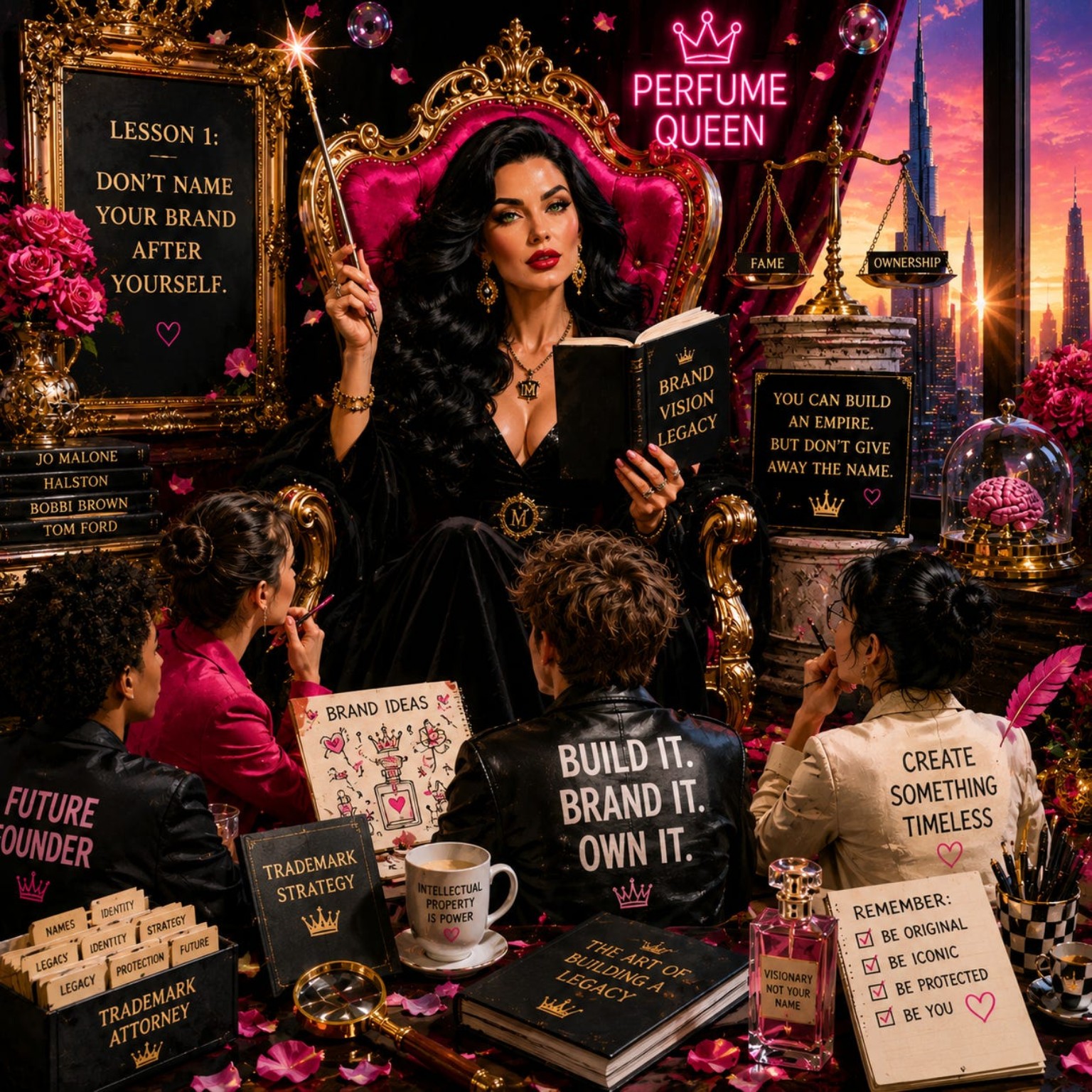
“Do not casually build a sellable company around your own personal name unless you fully understand what you may eventually be giving away.”
Years ago, when I discussed trademarks with my trademark attorney, his advice was immediate:
“Please don’t trademark your business in your own name.”
Because if you eventually sell that business, you may also be selling the commercial rights attached to your identity within that category.
Meaning: you may never again be able to freely use your own name in the industry you built your reputation in.
That’s enormous.
And frankly, most founders don’t think that far ahead when they’re starting out from a tiny shop or kitchen table with £300 and a dream held together by caffeine and blind optimism.
Jo Malone probably wasn’t imagining a future lawsuit when she first started selling scented products in London.
Most founders don’t.
But this case is now becoming a masterclass in why naming strategy matters.
There’s an irony in teaching branding while simultaneously becoming embroiled in a branding lawsuit.
Still… there’s also something deeply human about all of this.
Because I don’t think this story is really about greed.
I think it’s about the strange emotional aftermath of selling something so personal that your own name no longer fully belongs to you commercially.
And that must feel extraordinarily odd.
As for what happens next?
Who knows.
Estée Lauder has very deep pockets. Zara has pretty deep pockets. The lawyers are probably already shopping for second yachts.
If you are building a brand today — fragrance, beauty, fashion, skincare, anything — think very carefully before naming it after yourself.
Because one day, you may wake up and discover you didn’t just sell a business.
You sold your own reflection.