
Icons
The Day Perfume Fell From the Sky
Carven Ma Griffe and the most theatrical fragrance launch in history.
By Melanie Jane
In post-war Paris, a plane flew over the Seine and dropped hundreds of perfume bottles onto the city.
Not leaflets.
Not confetti.
Perfume.
Which is either one of the most romantic launches in fragrance history… or the moment the French collectively decided subtlety was overrated.
The perfume was Ma Griffe by Carven.
Translated literally, it means My Signature — although my claw is technically closer. Which feels wonderfully dramatic for a fragrance that would eventually slash its way through perfume history like a woman in green silk with absolutely no intention of apologising for herself.
And honestly? The launch suited the perfume.
Because Ma Griffe wasn’t delicate.
It was green. Sharp. Elegant. Unmistakably French. The sort of fragrance that walks into a room, lights a cigarette in its imagination, and silently judges your curtains.
Madame Carven and the Green Stripes
The house of Carven was founded by Madame Carven, born Carmen de Tommaso, a petite couturière who became famous for designing elegant fashion for smaller women at a time when haute couture seemed determined to dress everyone as if they were six feet tall and emotionally exhausted.
She adored the colour green.
Not timid little pastel green either. Proper vibrant green.
The iconic green-and-white striped box of Ma Griffe — with its unmistakable diagonal stripes — was reportedly inspired by one of her favourite dresses. Bold striped fabric that became part of the brand’s visual identity.
Even today, vintage Ma Griffe boxes look impossibly chic. Like something discovered in an antique Paris apartment hidden beneath silk gloves and unpaid love letters.
Perfume Rain Over Paris
When Ma Griffe launched in 1946, Europe was still emerging from the shadow of war.
Paris needed glamour again.
And Carven decided the best way to announce a perfume to the world was apparently to involve aviation.
A plane flew over the Seine releasing hundreds of miniature bottles of Ma Griffe attached to tiny parachutes, drifting down over Paris in green-and-white striped boxes like fragrant little soldiers of glamour.
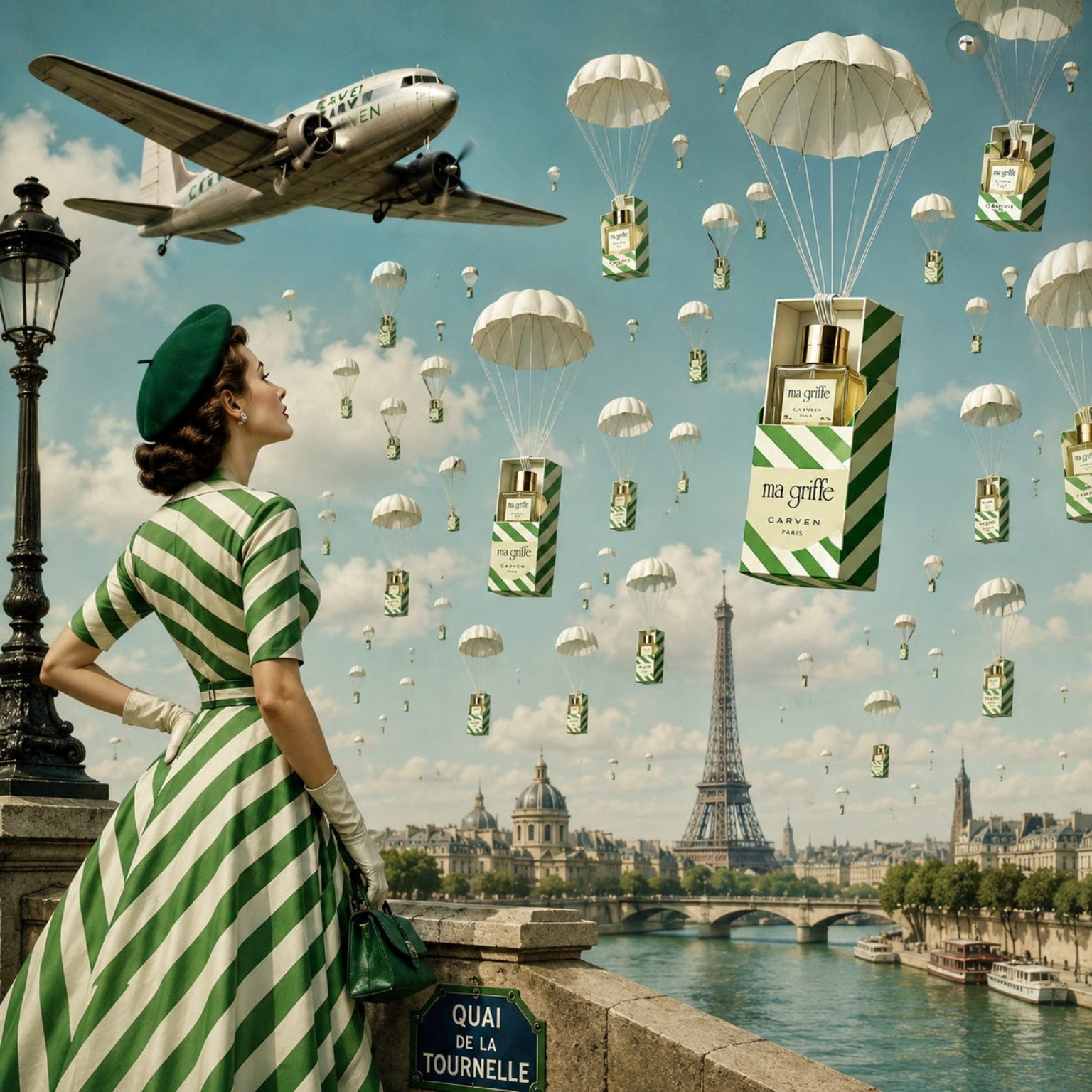
Can you imagine it?
You’re walking beside the Seine after the war, probably thinking about bread rationing and existentialism, and suddenly perfume starts floating down from the sky.
Very French. Very theatrical. Mildly dangerous.
Modern health-and-safety departments would have a collective aneurysm.
Naturally, the stunt worked beautifully.
The perfume became iconic.
The Scent Itself
Ma Griffe was created by perfumer Jean Carles, one of the great architects of French perfumery and the man whose teaching method still influences perfumers today.
The fragrance was unapologetically green:
- galbanum
- clary sage
- aldehydes
- jasmine
- rose
- oakmoss
- vetiver
It smelled alive.
Sharp leaves snapped between the fingers. Wet stems. Mossy air. Flowers with thorns still attached.
But alongside all that green brilliance was something else: powder.
Vintage Ma Griffe carries that beautifully powdered elegance so characteristic of post-war French perfumery. The aldehydes soften the sharpness just enough, giving the fragrance a polished cosmetic quality beneath all that green severity.
This was not a sugary little people-pleaser.
Ma Griffe belonged to the great generation of perfumes that assumed women were intelligent enough to enjoy complexity.
A radical concept, apparently.
The Claw
Carven leaned beautifully into the double meaning of the name.
Vintage advertisements for Ma Griffe featured a woman’s hand with long lacquered nails dragging down a man’s back, leaving vivid red scratch marks behind her.
Not subtle.
Not delicate.
Not remotely sorry about it.
The imagery was sensual, elegant, and just threatening enough to make it unforgettable.
Which, frankly, describes most great French perfumes.
The Guerlain Connection
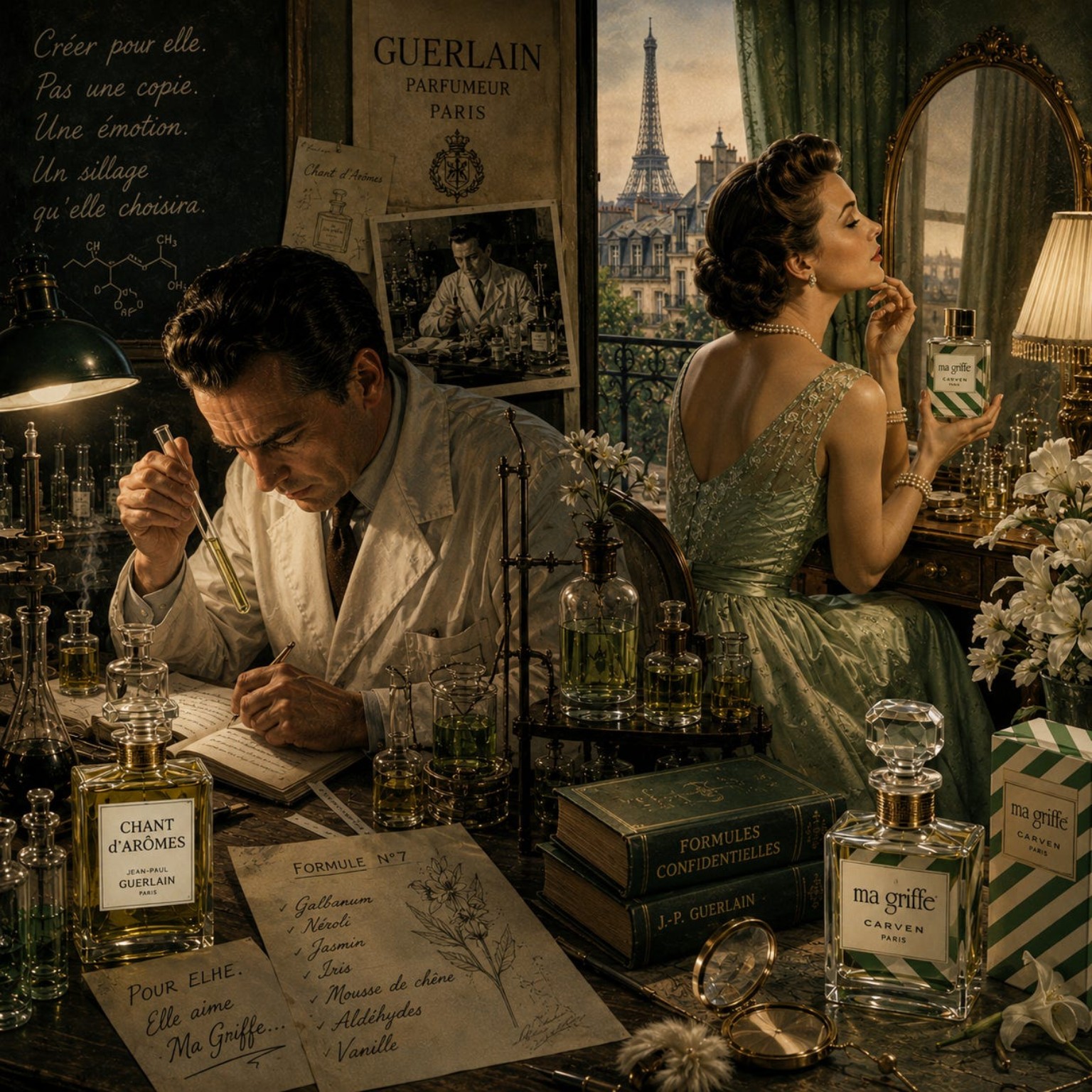
One of the most fascinating perfume rumours surrounding Ma Griffe involves Jean-Paul Guerlain.
According to perfume lore, his fiancée adored Ma Griffe and refused to wear anything else — including Guerlain fragrances, which one imagines bruised the family ego ever so slightly.
So Guerlain allegedly decided to create a fragrance inspired by the perfume she loved.
That fragrance became Chant d’Arômes.
And when you smell vintage versions of both fragrances side by side, the resemblance is uncanny.
The same luminous green floral elegance. The same graceful bitterness. The same polished Parisian aloofness. The same powdered sophistication beneath the florals.
Which is, frankly, one of the most French romantic gestures imaginable:
“If she refuses to wear my perfume, I shall simply recreate the perfume she already likes.”
Honestly, men used to write symphonies. French perfumers just reverse-engineered each other’s girlfriends.
The Final Fate
Ma Griffe survived for decades, but like many legendary perfumes, reformulation slowly changed its character.
Restrictions on ingredients such as oakmoss altered the structure of countless classic fragrances throughout the late twentieth and early twenty-first centuries. The rich mossy depth that once defined many French perfumes became increasingly difficult to recreate in the same way.
Eventually Ma Griffe faded from mainstream perfume counters and slipped into the realm of collectors, vintage hunters, and perfume obsessives who speak about discontinued fragrances the way historians discuss lost civilisations.
Vintage bottles still circulate online and in private collections, often treasured for their unmistakable green brilliance and the memory of what perfume once smelled like before everything became vaguely edible.
And somewhere in perfume history remains the glorious image of tiny green-striped bottles floating down from the Paris sky.
Not a bad legacy for a perfume called My Claw.