Icons
Shalimar: The Perfume That Refused to Leave the Room
Before Shalimar became Shalimar — before the blue stopper, the smoky vanilla, the century of devotion, and the women who wore it like a private doorway into drama, silk, and candlelight — there was Jicky.
By Melanie Jane
Created in 1889 by Aimé Guerlain, Jicky was a scandal in a bottle. Not because it was loud or vulgar, but because it was modern. It combined natural materials with new synthetic molecules at a time when perfumery was still expected to behave itself, wear gloves, and smell like a polite bouquet.
Jicky did not behave.
It was lavender, citrus, woods, warmth, civet, coumarin and vanillic softness — half gentleman’s cologne, half whispered secret, and entirely ahead of its time.
Then came Jacques Guerlain.
According to the most repeated Guerlain story, Jacques discovered ethylvanillin through his chemist friend Justin Dupont. Ethylvanillin was more powerful and radiant than natural vanilla alone — a small material with a rather dramatic entrance, like someone arriving late to dinner and immediately becoming the reason everyone stays.
Legend says Jacques added a few drops of it to Jicky.
Some versions call it an accident. Some call it an experiment. Either way, the result was not merely “Jicky with extra pudding.” It was deeper, warmer, darker, more sensual.
The structure shifted.
The fresh aromatic brightness of Jicky was pulled into shadow and velvet. Vanilla stopped being sweet and became architectural. It gave the perfume depth, warmth, body and that famous Guerlain purr — the olfactory equivalent of lowering the lights and suddenly making the room much more interesting.
That is where Shalimar begins: not as a polite floral, but as a transformation.
Its inspiration came from the legendary love story of Emperor Shah Jahan and Mumtaz Mahal — the grief-struck romance behind the Taj Mahal and the gardens of Shalimar. It was a story of love, loss, beauty, devotion and excess. Naturally, perfume turned up wearing eyeliner and said, “I’ll handle this.”
And then there was the bottle.
When Shalimar launched in 1925, it did not arrive quietly. It arrived dressed for the Exposition Internationale des Arts Décoratifs et Industriels Modernes in Paris — the great Art Deco exhibition that helped define the visual language of the age. Naturally, Shalimar turned up looking like it owned a chaise longue and had opinions about lighting.
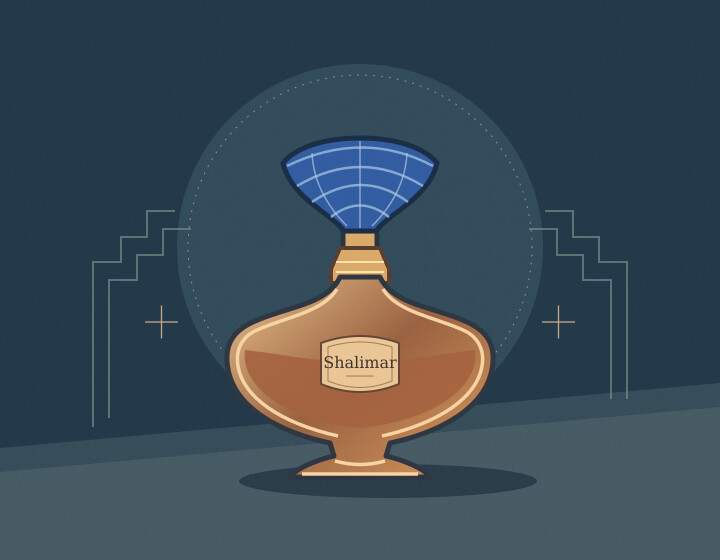
The original flacon, designed by Raymond Guerlain, was inspired by the fountains and basins of the Shalimar gardens, with that now-famous sapphire-blue fan stopper sitting proudly on top like a jewel with excellent posture. It was not simply packaging. It was theatre. A tiny glass palace for one of perfumery’s most enduring seductions.
For collectors, the early bottles have their own private language. The Baccarat crystal flacons are especially prized, but dating them is not always straightforward. Baccarat only began systematically engraving its mark from 1936; before that, bottles could be acid-etched, stamped, labelled, numbered, or not obviously marked at all. And because many early stoppers were individually ground to fit their matching bottle, you often find tiny etched numbers on both pieces — a quiet little marriage between stopper and flacon.
Lose one, and the other sulks forever.
But Shalimar was never just about the bottle.
Its structure was the real genius: bergamot brightness over a warm, sensual base of vanilla, balsamic notes and tonka bean, with iris, jasmine and rose giving elegance through the heart.
This is what made Shalimar so powerful. It was not sweet in the modern cupcake sense. It was smoky, soft, powdered, leathery, intimate and grand all at once.
That contrast is everything.
Cold light at the top. Amber shadow underneath.
A perfume with cheekbones.
And then, of course, time started doing what time does best: meddling.
Like many great heritage perfumes, Shalimar has had to live through changing tastes, changing raw materials, changing production methods, and the joyless little clipboard parade of modern regulations. The old masterpieces did not get to sit peacefully in their velvet boxes. They were dragged into the modern regulatory office, handed a form, and told to behave.
This is where reformulation becomes delicate.
We should not say, “Shalimar was ruined,” because that is too blunt and not properly evidenced. Better to say this: Shalimar, like many classics, has had to be protected, adjusted and rebalanced so that its spirit remains recognisable even when the palette around it changes.
That is the real work of preserving an icon. Not freezing it in amber, but keeping its pulse alive.
By the time the 1980s arrived, fragrance culture had changed again. Perfume was no longer politely sitting on a dressing table waiting to be dabbed behind one ear. It had shoulder pads. It had Dynasty hair. It had a taxi account and a lunch reservation.
This was the age of Opium, Poison, Giorgio Beverly Hills, Coco and Obsession — perfumes with volume, projection and absolutely no interest in whispering.
There are rumours that Shalimar was one of the fragrances caught up in those famous stories of restaurants objecting to overpowering perfume, but the clearest documented example points to Giorgio Beverly Hills rather than Shalimar itself.
Still, Shalimar absolutely belonged to the wider conversation about perfumes with presence.
And Shalimar had presence in abundance.
It was not new-money loud. It was not neon and hairspray. It was older, deeper, more assured. The 80s may have been full of perfumes kicking the door open, but Shalimar simply raised one eyebrow from a velvet chair and let everyone else exhaust themselves.
In the 1920s, Shalimar was exotic, elegant and daring.
By the 1980s, it had become something else as well: a power perfume. Not because it shouted the loudest, but because it had the confidence of a woman who didn’t need to explain why she was wearing lipstick, fur, amber vanilla and enough presence to make a room rearrange itself.
By the end of the 1980s, Shalimar had done something rare. It had survived changing fashions, new rivals, louder perfumes, shifting regulations and the slow march from crystal flacons to department-store counters. It was no longer simply Jacques Guerlain’s tribute to a legendary love story. It had become part of women’s lives — dressing tables, handbags, memories, mothers, grandmothers, lovers, hotel lifts, theatre foyers, and the lingering trace of someone fabulous who had already left the room.
And this is where Shalimar becomes more than a perfume story.
Because a hundred years after Jacques Guerlain created it, Shalimar is still being discussed, reimagined, protected, argued over, worn, collected and loved. That alone is extraordinary. Most perfumes don’t get a decade. Shalimar got a century and still managed to keep her eyeliner sharp.
Today, the house of Guerlain is no longer guided only by the Guerlain family line. In 2008, Thierry Wasser became Guerlain’s in-house perfumer — the first perfumer from outside the Guerlain family to hold that position. He did not create Shalimar, obviously, unless he has access to a time machine and a very convincing Art Deco waistcoat. But he became one of the people entrusted with preserving Guerlain’s olfactory heritage while moving it forward.
And that matters.
Because keeping a perfume like Shalimar alive is not simply a case of dusting off the old formula and saying, “There you go, darling, history in a bottle.” Raw materials change. Regulations change. Tastes change. The world changes. The job is not to embalm the perfume. The job is to keep its soul breathing.
For Shalimar’s centenary, Guerlain introduced Shalimar L’Essence, composed by Delphine Jelk, Guerlain’s Director of Perfume Creation. It pays tribute to the original while placing even more emphasis on vanilla — that material which has haunted Shalimar from the beginning, from Jacques Guerlain’s ethylvanillin experiment to its modern, deeper, more contemporary expression.
And then, beautifully, the story comes back to people.
I met Thierry Wasser in Grasse, at SIMPPAR, during the Lavender Awards, after somehow finding myself in the VIP area — as one does, when perfume and shameless optimism are involved. He was everything you hope someone like that will be and so many people are not: warm, generous, humble, funny, and genuinely interested in talking about fragrance.
My friend Stéphanie was taking photos of us, and because I am apparently incapable of receiving a compliment without wrestling it to the floor, I said something ridiculous about not photographing my profile.
Thierry looked genuinely surprised.
He told me there was no such thing as ugly. That beauty was not just physical. It was confidence, presence, spirit — the way someone inhabits themselves. Which, frankly, is the sort of thing that sounds nauseating when printed on a cushion, but when said by Thierry Wasser in Grasse, with perfume people milling around and lavender prizes being handed out, becomes annoyingly moving.
Later, I showed the photos to the group I’d met that evening, and they laughed because one of them looked like a wedding portrait. The happy couple. Me and Thierry, gazing at each other like we’d just signed a register and were about to cut a cake scented with bergamot and vanilla.
It wasn’t that, obviously.
It was simply two people meeting through perfume.
And that is the part people outside this industry often don’t understand. Fragrance is not just liquid in a bottle. It is memory, craft, chemistry, culture, agriculture, ritual, history, emotion, and occasionally a very flattering photograph with a master perfumer.
In his Vogue Arabia interview, Thierry spoke about the Middle East, about learning from the region’s rituals and materials, and about the importance of scent as something lived rather than merely worn. He spoke of discoveries such as Taif rose, and the way fragrance traditions reveal themselves through people, gestures and culture.
That, for me, is the real ending to the Shalimar story.
Not that Shalimar turned one hundred.
Not that Guerlain released another beautiful version.
Not even that I finally met Thierry Wasser — although, frankly, I am still dining out on that and will continue to do so until somebody forcibly removes the story from my handbag.
The real point is this: even the masters are still learning.
A perfumer can have decades of experience, access to the finest materials in the world, and a seat inside one of the greatest perfume houses in history — and still be inspired by a rose, a ritual, a conversation, a culture, a person.
That is why fragrance remains endlessly fascinating.
Nobody knows everything.
Not the students. Not the teachers. Not the collectors. Not the brands. Not even the people guarding the great formulas behind very expensive doors.
Every meeting teaches something. Every culture adds something. Every material has another face when seen through someone else’s tradition.
And that is why Shalimar still matters.
It began as a legend: Jicky, ethylvanillin, Jacques Guerlain, a love story, a blue stopper, a palace garden, a bottle shaped like desire with excellent posture.
It survived a century.
And now, in the hands of people like Thierry Wasser and Delphine Jelk, it continues — not as a relic, but as a living lesson.
A reminder that perfume is never finished.
It simply leaves a trace, waits for the next person to follow it, and teaches them something new.