Trips
I Went to Shanghai for Perfume. I Came Back with More Photos of Dogs.
NOTES Shanghai, Chinese oud, flowers I could actually smell and a city I didn’t want to leave.
By Melanie Jane
I went to Shanghai for NOTES, a fragrance exhibition on the West Bund. I had a professional plan: smell what the independent brands were making, meet the people behind them, investigate raw materials, and come home with stories to tell.
I did all that. I also came home with more photographs of dogs in prams than perfume bottles. This was not in the plan.
The show was full of smaller, independent fragrance houses looking for retailers. That is one of the things people forget when they see the lovely bottles: a brand can make a beautiful perfume, but it still has to find somebody willing to put it on a shelf. I even met a Saudi-based fragrance brand in Shanghai, seeking its place in that market. You travel halfway across the world to explore Chinese perfumery and bump into someone from just up the road. Typical.
But the Chinese brands were what kept pulling me back. I can only speak for the perfumes I smelled, and I smelled some bloody beautiful ones. They felt cleaner and fresher than many of the heavier, ambery fragrances I had recently encountered in the Middle East. There was complexity, but it lived inside a kind of simplicity. If somebody presented a jasmine fragrance, I could smell the jasmine. If it was a floral, the flower was allowed to be a flower.
That may sound obvious, but spend enough time smelling commercial perfume and you will find yourself asking, “Where's the jasmine, then?” It can disappear beneath so many other materials that the flower on the label feels like a rumour. In Shanghai, I kept finding scents with room to breathe.
A Chinese oud seller called Jeff
Away from the finished perfumes was a small materials section. It wasn't an endless Beautyworld-style sprawl: I reckon there were perhaps a dozen or so suppliers. Getting in involved a separate payment of around 500 yuan, which I hadn't quite grasped. Everyone seemed to be paying for everything with WeChat or Alipay. I was still at the stage of wondering where my WhatsApp had gone.
The woman at reception took pity on me and let me in anyway. Perhaps I reminded her of an eccentric aunt.
Either way, I came away with a sample pack from the materials exhibitors and one of the most interesting conversations of the trip.
His name was Jeff. A Chinese man called Jeff, teaching me about Chinese oud.
Jeff was with Yuzhi Oud, and he showed me different pieces of agarwood and an eight-part discovery set of Chinese oud oils. I asked why we hear so much about oud from Cambodia, India and Laos, yet relatively little about Chinese oud. His answer was wonderfully blunt: they had wanted to keep it for themselves. Now, he said, they were managing the trees and wanted to share what they produced.
He showed me wood from trees treated to encourage the fragrant resin to develop, alongside pieces he described as naturally affected by ants. He talked me through their different appearances and values.
Then I asked the question I always want to ask when I see agarwood for sale: how can a buyer tell what is genuine?
Jeff warned me about ordinary pale wood being dyed dark and showed me the variation of light, dark and pale areas in the pieces he was handling. I interviewed him on camera, and I'll share that fuller conversation on YouTube. Eight oud samples are waiting for me at home. I am trying to behave like a professional and smell them methodically rather than opening the lot like Christmas presents.
From Sicily, via Shanghai
In the same materials area I met Mohamed, who works with a Sicilian company making speciality natural extracts. He showed me citrus oils from which phototoxic furocoumarins had been removed, and told me about a white wine extract for perfumery. White wine in a fragrance? You had me at wine.
There was also a rose material made by concentrating aromatic constituents remaining in rose water after distillation. Mohamed described a process that concentrates it around a hundredfold. It didn't smell simply like another bottle of rose essential oil; it offered a different profile. He had natural banana and strawberry extracts too. I interviewed him, and he invited me to visit in Sicily next year to see the fruit, the harvesting and the extraction work for myself. That is precisely the sort of invitation I want to follow up: go to where a material begins, meet the people making it, and show you what actually happens.
What does “oriental” smell like to you?
At dsm-firmenich, I picked up a brochure called Flowers Are Watching Us. I also had a conversation with a Chinese woman working there that has stayed with me more than any trend forecast.
I asked what she made of the fragrance industry's shift from calling a scent family “oriental” to calling it “ambery”. I wondered aloud whether it was about being inclusive, or what you might call woke. I don't mind asking awkward questions.
The Mandarin Oriental Hotel hasn't rushed to change its name, has it?
Her answer wasn't the one I expected. She told me that what “oriental” suggests in China can be quite different from what the term suggests in a Middle Eastern fragrance context. She described a Chinese interpretation with lighter woods, flowers, herbs, seeds and fruits—even foods—without necessarily turning into a pudding of a gourmand.
The heavier amber and wood association I had in mind was only one way of understanding it.
That was one woman's explanation, from inside the industry, and it made me stop. We can spend ages arguing over a category name while assuming everybody imagines the same smell when they hear it. They don't. I had gone in with a question about a word and come out thinking about the noses, places and lives behind it.
There were moments I admired less. At one talk, a brand representative said a new fragrance contained real ambergris and real Chinese deer musk used in traditional medicine. The ambergris caught my attention; the deer musk made me recoil. My immediate thought was: what happened to the poor animal? Calling an ingredient natural, rare or traditional doesn't settle the question of how it was obtained. I want to know the answer before I applaud the perfume. Using real musk is nothing to be proud of.
And then there was Shanghai
I stayed at UR Cove by Hyatt on the West Bund, with a balcony looking over the river. Waking up there made me ridiculously happy. I spent my evenings downstairs at Paulaner, a German bar whose menu I made a fairly determined attempt to investigate. I also found a tapas bar with a happy hour and steak and foie gras so good I am still thinking about it.
People were kind to me when my Mandarin ran out—which was almost immediately. Phones appeared, translations happened, and conversations carried on. I loved the fashion. Some people looked as though they had walked straight out of Comic-Con, and nobody seemed remotely bothered by what I was wearing either. Scarves, hats, boots, jewellery: in Shanghai I could dress like myself without anyone doing that little double take. It was glorious.
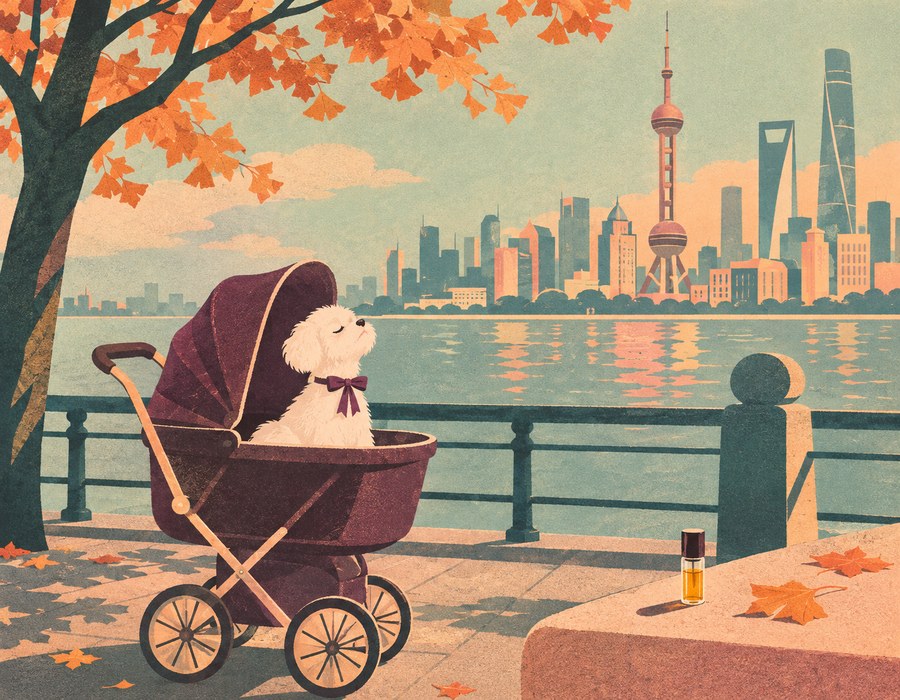
And the dogs. I’d never seen so many. Most of the little ones I noticed were white, and an astonishing number were in prams. There were giant poodles with immaculate pom-poms too, and a chihuahua being placed carefully on a bench while its owner gave it a comb and scissor tidy-up.
I saw small animals being carried around, and even shops devoted to birthday cakes for dogs. I could have sworn one little dog had its own motorised car. By the end of the trip, my camera roll suggested I had attended an international convention for very pampered pets.
Some of the fragrance brands were just as inventive about how scent could be carried: solid perfumes, roll-ons, pieces worn like jewellery. Between that playfulness, the materials conversations, and the flowers I could actually smell in the perfumes, I found an industry eager to show me its own ideas.
Olivier, Olivier, wherefore art thou, Olivier?
I was wandering around with my Osmo Pocket 3 when I came upon Akro, Olivier Cresp's brand.
There was his gourmand fragrance Crush in its beautiful pink bottle, with enormous pink macarons on display. Macarons, by the way—the pretty little sandwich biscuits with a filling. Macaroons are a different thing.
Akro says Crush is inspired by rose macarons, with roasted almond and lychee on top, Bulgarian rose and praline in the middle, and vanilla underneath. I should probably have asked more about the perfume. You can see what happened instead.
“Olivier, where are you? Olivier?” I was calling into the stand with my camera, not imagining for one second that he'd actually be there.
“I'm here!”
Of course he was. It's his brand. I was still ridiculously excited.
We'd met at Pitti Fragranze in Florence in 2024, where I pestered him into a tiny video. I asked what he would be if he weren't a perfumer. A farmer, he said, planting vegetables. From Angel to aubergines, in about twenty seconds.
This time I asked whether he'd let me interview him properly. He said yes, of course. I set up the little Osmo and proceeded to ask him all manner of random questions. We did speak a little about Crush, though I suspect he might have appreciated a few more questions about the perfume beneath the giant macarons. What I came away with was nearly eight minutes with Olivier Cresp, which still feels extraordinary. I'll share the full conversation on YouTube.
Then came the selfies. And, because apparently an interview with one of the world's best-known perfumers wasn't quite surreal enough, I gave him a signed copy of my feral adult fairy tale, Skankabel. I have absolutely no idea what he'll make of it. Olivier Cresp now owns a book signed by me. I'm still processing that sentence.
For now, this is what I want to say about Shanghai: I went to work, and I fell in love.
With the perfume, the people, the fashion, the river, the dogs and the freedom of being a flamboyant, eccentric woman nobody felt the need to stare at.